
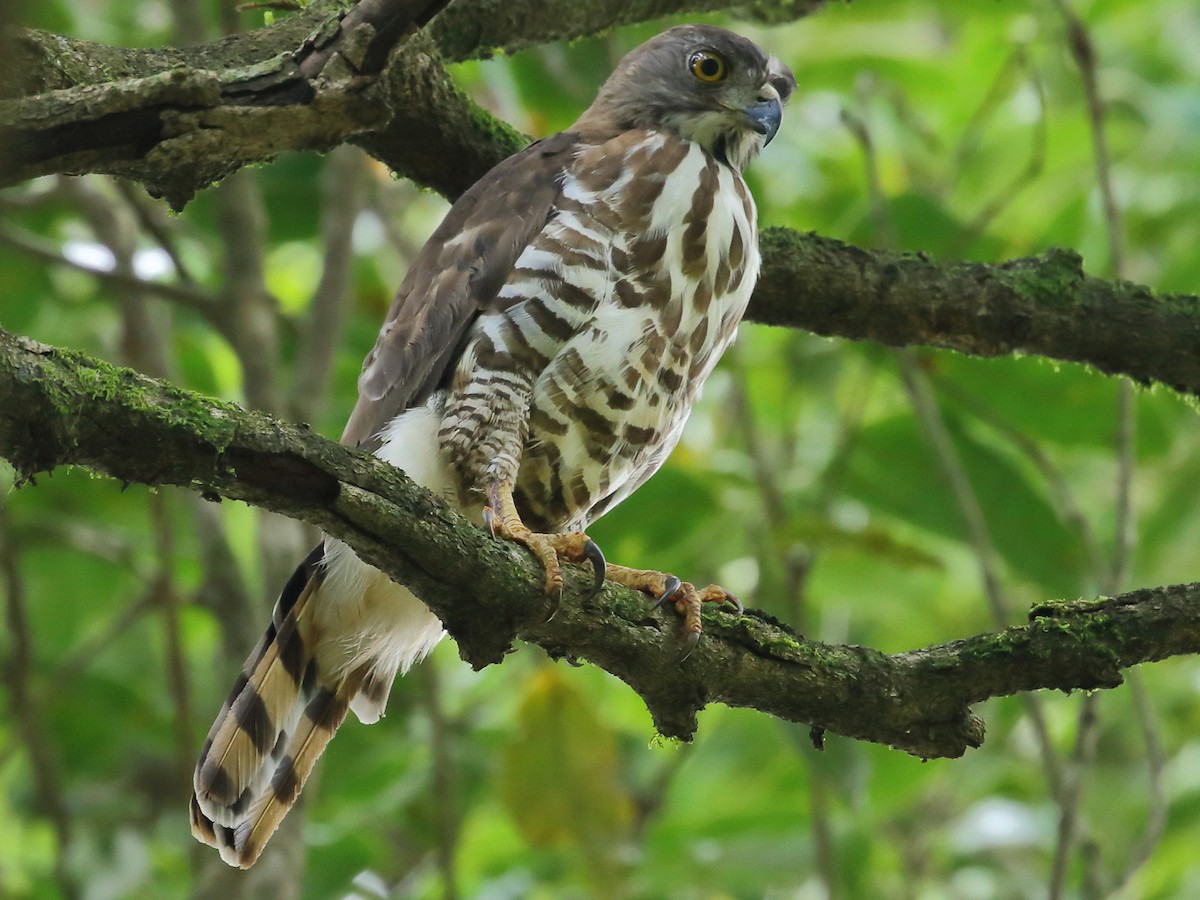
ƯNG NGỖNG MÀO
Tên khoa học: Accipiter trivirgatus
Họ: Ưng Accipitridae
Bộ: Cắt Falconiformes
Ó mào (danh pháp hai phần: Accipiter trivirgatus) là một loài chim săn mồi thuộc họ Ưng ở châu Á nhiệt đới. Loài chim ăn thịt này có cánh ngắn và rộng và đuôi dài giúp nó di chuyển qua các cây dễ dàng. Thân dài 30–46 cm, con mái lớn hơn nhiều so với con trống. Loài này sinh sản ở ở miền Nam Á, từ Ấn Độ và Sri Lanka tới miền nam Trung Quốc, Indonesia và Philippines. Nó chủ yếu là sinh sống ở vùng đất thấp, và định cư quanh năm. Ngay cả ở môi trường sống vùng cao, nó vẫn định cư vào mùa đông, ví dụ như ở chân núi Himalaya của Bhutan hoặc trong rừng Sal (Shorea robusta) ở huyện Ấn Độ huyện Dehradun. Trong những vùng đất ở cuối phía bắc của phạm vi của nó, nó thường rất hiếm khi hiện diện. Về cơ bản phạm vi phân bố loài chim này được giới hạn ở xứ nhiệt đới và cận nhiệt đới ấm áp. Chúng săn bắt chim, động vật có vú và động vật bò sát, chúng lao xuống từ trên cao thình lình chụp con mồi phía dưới. Loài chim này xây tổ trên cây và đẻ 2-3 quả trứng. Ký sinh trùng trên loài chim này có Degeeriella storeri. Thuộc nhóm IIB theo Thông tư 85/2025 của Bộ Nông nghiệp và Môi trường. (Nguồn: vncreatures.net).
Crested Goshawk
Scientific Name: Accipiter trivirgatus
Family: Accipitridae (Hawks, eagles, and allies)
Order: Accipitriformes (Diurnal birds of prey)
Description and Morphological Metrics
+ General Overview: The Crested Goshawk (Accipiter trivirgatus) is a medium-sized diurnal raptor belonging to the family Accipitridae, native to tropical and subtropical zones of Asia.
+ Aerodynamic Adaptation: This forest-dwelling predator features characteristically short, broad wings and a elongated tail—ecomorphological adaptations that maximize maneuverabilityand agile flight through dense canopy matrices and complex woodland understories.
Dimensions and Weight:
+ Total Length: Varies from 30 to 46 cm (12 to 18 in).
+ Reverse Sexual Dimorphism: Like most accipitrids, this species exhibits pronounced reverse sexual dimorphism, with females being substantially larger and heavier than males.
Distribution and Habitat Preferences
+ Geographic Range: The breeding distribution spans Southern and Southeastern Asia, extending from India and Sri Lanka eastward to southern China, and southward through the Indonesian archipelago and the Philippines.
+ Habitat and Altitudinal Zoning: It is primarily a lowland specialist and remains a sedentary, year-round resident throughout most of its range. Even in highland margins at the northernmost limits of its distribution, populations remain non-migratory during winter, as documented in the Himalayan foothills of Bhutan and the subtropical Sal (Shorea robusta) forests of the Dehradun district in India.
+ Abundance and Climate Constraints: It is exceptionally scarce or occurs at low population densities in the northernmost peripheries of its range. Its ecological distribution is strictlybounded by tropical and warm subtropical macroclimates.
Foraging Dynamics and Diet
+ Dietary Breadth: An opportunistic ambush predator with a varied diet consisting of small birds, small mammals (such as rodents and bats), and reptiles (predominantly lizards).
+ Hunting Mechanics: It utilizes a “sit-and-wait” perching strategy, concealing itself within dense foliage before executing a sudden, rapid aerial stoop or ambush dive to pin terrestrial orarboreal prey with its powerful talons.
Reproduction and Ectoparasites
+ Nesting & Breeding Biology: The species constructs an arboreal stick nest (a platform structure of twigs and branches lined with green leaves) high in the forest canopy. The typical clutchsize consists of 2 to 3 eggs.
+ Host-Parasite Associations: The species is a documented host for the avian chewing louse Degeeriella storeri(Phthiraptera: Philopteridae), a highly host-specific ectoparasite.
Conservation Status and Regulations
+ Domestic Legislation: Regulated and protected under Group IIB according to Circular 85/2025 of the Ministry of Agriculture and Environment.
(Source: vncreatures.net)
Хохлатый ястреб
Латинское название: Accipiter trivirgatus
Семейство: Ястребиные (Accipitridae)
Отряд: Ястребообразные (Accipitriformes)
Описание и морфометрические показатели
+ Общий обзор: Хохлатый ястреб (Accipiter trivirgatus) — дневная хищная птица семейства ястребиных, обитающая в тропических регионах Азии.
+ Аэродинамическая адаптация: Этот лесной хищник обладает характерными короткими, широкими крыльями и длинным хвостом. Данные морфологические особенностиобеспечивают высокую маневренность и позволяют птице легко лавировать среди густых крон деревьев и в подлеске.
Параметры тела:
+ Общая длина тела: Составляет от 30 до 46 см.
+ Половой диморфизм: Как и у большинства ястребиных, выражен обратный половой диморфизм — самки значительно крупнее и массивнее самцов.
Ареал и стации обитания
+ Географическое распространение: Гнездовой ареал охватывает Южную и Юго-Восточную Азию: от Индии и Шри-Ланки до Южного Китая, Индонезии и Филиппин.
+ Стации и оседлость: Преимущественно низменный (равнинный) вид, ведущий строго оседлый образ жизни в течение всего года. Даже на высокогорных участках у севернойграницы ареала популяции остаются зимовать на местах, например, в предгорьях Гималаев в Бутане или в субтропических саловых лесах (Shorea robusta) в индийском округеДехрадун.
+ Плотность популяций: На крайних северных рубежах своего ареала вид встречается крайне редко. Географическое распространение хохлатого ястреба жестко лимитированотропическими и теплыми субтропическими климатическими зонами.
Рацион питания и охотничье поведение
+ Спектр питания: Рацион разнообразен (эврифагия) и включает мелких птиц, млекопитающих (грызунов, летучих мышей) и рептилий (преимущественно ящериц).
+ Механизм охоты: Охотится методом засады («подстерегания с присады»), скрываясь в густой листве и совершая внезапный стремительный бросок вниз для захвата жертвымощными лапами с цепкими когтями.
Размножение и паразитофауна
+ Гнездовая биология: Обустраивает платформенные гнезда из веток на деревьях. Кладка состоит из 2–3 яиц.
+ Паразитарные связи: На данном виде ястребов паразитирует пухоед Degeeriella storeri (отряд Phthiraptera) — узкоспециализированный эктопаразит птиц.
Охранный статус и регуляция
+ Национальное законодательство: Относится к Группе IIB согласно Циркуляру 85/2025 Министерства сельского хозяйства и окружающей среды Вьетнама.
(Источник: vncreatures.net)
Đánh giá
Chưa có đánh giá nào.